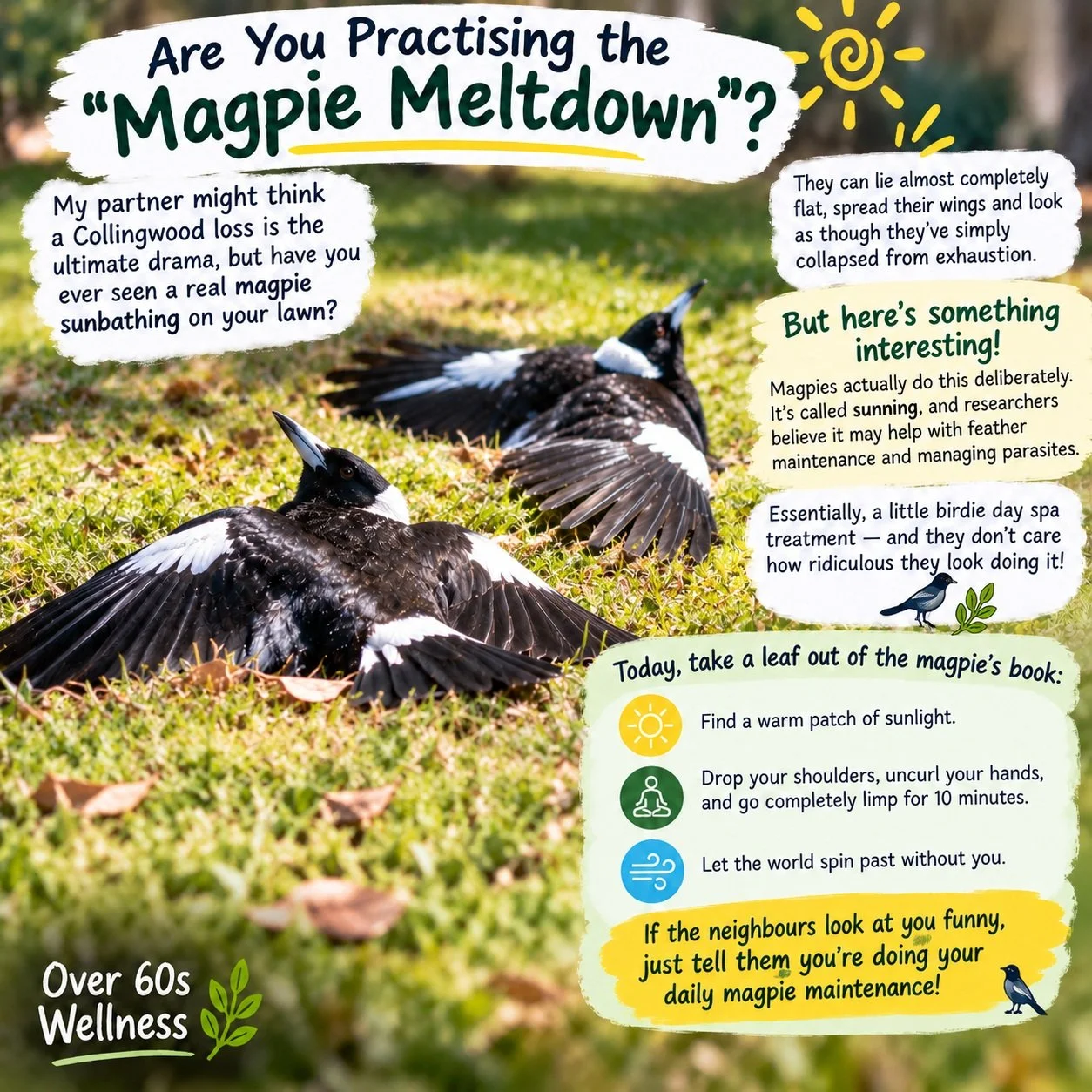
Are You Practising the Magpie Meltdown? 🐦☀️
And no, I'm not talking about Collingwood supporters after a disappointing weekend! 😂
Have you ever noticed a magpie lying on the ground in the sunshine, wings spread, feathers fluffed out, looking as though it's completely given up on life?
The first time you see it, you might wonder whether the poor bird is unwell.
But there's a rather interesting explanation.
Magpies sometimes deliberately sunbathe!
They can spread their wings, fan their tails and expose their feathers to direct sunlight, occasionally looking remarkably like they've suffered a complete meltdown.
And apparently, there's more to it than simply enjoying a warm afternoon.
Why do magpies do this?
Bird researchers have observed sunning behaviour across numerous species, including magpies.
There are several possible explanations.
Sunlight may assist with feather maintenance, help birds manage parasites or provide warmth. Researchers are still investigating the precise functions of this behaviour, and different species may sun themselves for different reasons.
But the interesting part is that these birds appear to deliberately stop what they're doing and spend time in the sunshine.
Which got me thinking.
When was the last time we deliberately stopped doing something and simply enjoyed a few minutes outside?
Perhaps the magpies are onto something
As we get older, we hear plenty about the importance of staying active.
And rightly so.
Regular physical activity, maintaining muscle strength, staying socially connected and keeping our minds engaged are all important components of healthy ageing.
But what about those moments when we're not actually doing anything?
We can become so focused on being productive, exercising, completing jobs around the house or keeping ourselves occupied that we sometimes overlook the value of simply taking a break.
Interestingly, research into spending time in natural environments suggests that even relatively brief periods outdoors can have benefits for psychological wellbeing.
A 2019 study published in Frontiers in Psychology examined how spending time in nature affected physiological markers of stress.
Researchers found that nature experiences lasting approximately 20–30 minutes were associated with particularly efficient reductions in salivary cortisol, a hormone involved in the body's stress response.
Now, that doesn't mean lying in the sunshine will magically solve our problems.
And unlike the magpies, we need to be mindful of Australia's ultraviolet radiation and the importance of sun protection.
But perhaps there is something worthwhile about giving ourselves permission to pause.
Not because we've earned it.
Not because we've finished everything on our to-do list.
But simply because taking a moment to enjoy our surroundings can be a pleasant part of everyday life.
A healthy ageing thought for the day
So here's a slightly unconventional suggestion.
Next time you see a magpie completely unroll itself in a warm patch of sunlight, perhaps take it as a reminder to slow down.
Find a comfortable spot outside, preferably somewhere with a little shade if the UV is high.
Put the phone away.
Look around.
Listen to what's happening.
And give yourself ten minutes without feeling obliged to accomplish anything.
You don't actually have to spread your wings or go completely limp on the lawn.
Although that might give the neighbours something to talk about! 😂
Perhaps healthy ageing isn't only about what we keep doing. It's also about recognising when it's perfectly reasonable to stop.
And if anyone asks why you're sitting outside doing absolutely nothing?
Just tell them you're practising your daily magpie maintenance! 🐦☀️
Research references
1. Bird sunning behaviour
Simmons, K. E. L. (1986). The Sunning Behaviour of Birds: A Guide for Ornithologists. Bristol Ornithological Club.
A detailed examination of sunning behaviour in birds, including possible explanations for the behaviour.
2. Nature exposure and stress reduction
Hunter, M. R., Gillespie, B. W., & Chen, S. Y.-P. (2019). Urban nature experiences reduce stress in the context of daily life based on salivary biomarkers.
Frontiers in Psychology, 10, Article 722.