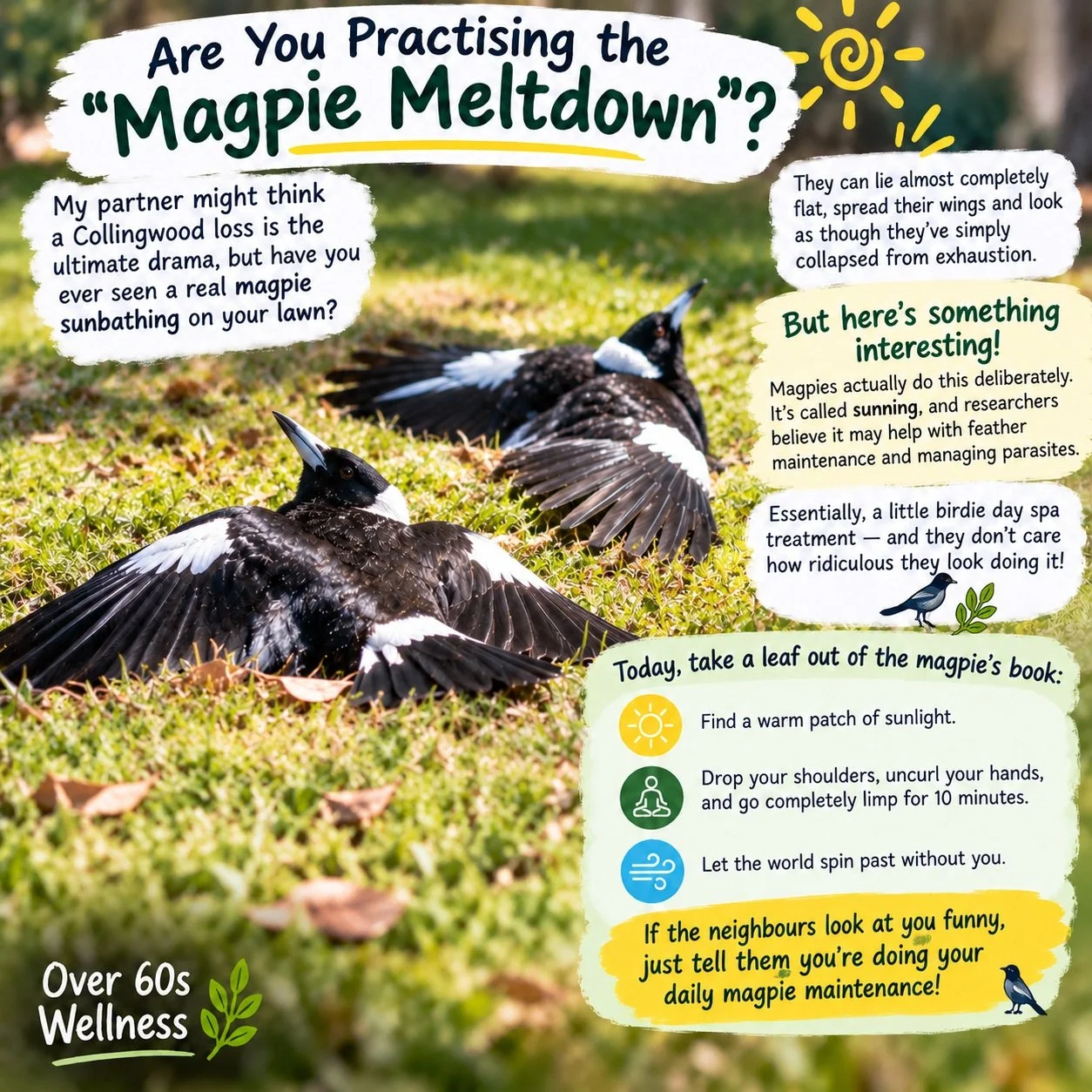
Are You Practising the Magpie Meltdown? 🐦☀️
And no, I'm not talking about Collingwood supporters after a disappointing weekend! 😂
Have you ever noticed a magpie lying on the ground in the sunshine, wings spread, feathers fluffed out, looking as though it's completely given up on life?
The first time you see it, you might wonder whether the poor bird is unwell.
But there's a rather interesting explanation.
Magpies sometimes deliberately sunbathe!
They can spread their wings, fan their tails and expose their feathers to direct sunlight, occasionally looking remarkably like they've suffered a complete meltdown.
And apparently, there's more to it than simply enjoying a warm afternoon.
Why do magpies do this?
Bird researchers have observed sunning behaviour across numerous species, including magpies.
There are several possible explanations.
Sunlight may assist with feather maintenance, help birds manage parasites or provide warmth. Researchers are still investigating the precise functions of this behaviour, and different species may sun themselves for different reasons.
But the interesting part is that these birds appear to deliberately stop what they're doing and spend time in the sunshine.
Which got me thinking.
When was the last time we deliberately stopped doing something and simply enjoyed a few minutes outside?
Perhaps the magpies are onto something
As we get older, we hear plenty about the importance of staying active.
And rightly so.
Regular physical activity, maintaining muscle strength, staying socially connected and keeping our minds engaged are all important components of healthy ageing.
But what about those moments when we're not actually doing anything?
We can become so focused on being productive, exercising, completing jobs around the house or keeping ourselves occupied that we sometimes overlook the value of simply taking a break.
Interestingly, research into spending time in natural environments suggests that even relatively brief periods outdoors can have benefits for psychological wellbeing.
A 2019 study published in Frontiers in Psychology examined how spending time in nature affected physiological markers of stress.
Researchers found that nature experiences lasting approximately 20–30 minutes were associated with particularly efficient reductions in salivary cortisol, a hormone involved in the body's stress response.
Now, that doesn't mean lying in the sunshine will magically solve our problems.
And unlike the magpies, we need to be mindful of Australia's ultraviolet radiation and the importance of sun protection.
But perhaps there is something worthwhile about giving ourselves permission to pause.
Not because we've earned it.
Not because we've finished everything on our to-do list.
But simply because taking a moment to enjoy our surroundings can be a pleasant part of everyday life.
A healthy ageing thought for the day
So here's a slightly unconventional suggestion.
Next time you see a magpie completely unroll itself in a warm patch of sunlight, perhaps take it as a reminder to slow down.
Find a comfortable spot outside, preferably somewhere with a little shade if the UV is high.
Put the phone away.
Look around.
Listen to what's happening.
And give yourself ten minutes without feeling obliged to accomplish anything.
You don't actually have to spread your wings or go completely limp on the lawn.
Although that might give the neighbours something to talk about! 😂
Perhaps healthy ageing isn't only about what we keep doing. It's also about recognising when it's perfectly reasonable to stop.
And if anyone asks why you're sitting outside doing absolutely nothing?
Just tell them you're practising your daily magpie maintenance! 🐦☀️
Research references
1. Bird sunning behaviour
Simmons, K. E. L. (1986). The Sunning Behaviour of Birds: A Guide for Ornithologists. Bristol Ornithological Club.
A detailed examination of sunning behaviour in birds, including possible explanations for the behaviour.
2. Nature exposure and stress reduction
Hunter, M. R., Gillespie, B. W., & Chen, S. Y.-P. (2019). Urban nature experiences reduce stress in the context of daily life based on salivary biomarkers.
Frontiers in Psychology, 10, Article 722.
🪓Could You Survive on Alone Australia? 🏕️☕
I love Alone Australia, and I have to say — imagine being dropped into the Tasmanian wilderness with little more than a handful of basic tools, your own knowledge and whatever nature provides.
No Google. No YouTube tutorials. No popping down to Bunnings when something breaks! 🛠️
But here's something interesting.
The very first season of Alone Australia was won by Gina Chick, who was 52 at the time. She survived an extraordinary 67 days in the Tasmanian wilderness, outlasting nine other contestants. We don't always give enough credit to as we get older — the practical knowledge, ingenuity and experience we've accumulated over a lifetime. 🧠
And here's some rather quirky research! In January 2026, researchers published a study in which adults of different ages were challenged to come up with creative ways to stop an egg from breaking when dropped from a height of 32 feet! And guess what? The older adults actually came up with more original solutions than their younger counterparts! 🌿
And then there's the coffee situation! ☕ Apparently, early European settlers even experimented with brewing Tasmanian sassafras bark as a substitute for tea. Not something I'd recommend trying without knowing whether it's safe! But it does raise an important survival consideration. I reckon I could manage without my phone or television.
But 67 days without a coffee? I might be tapping out before breakfast! 😂☕
1. Creativity and ageing — January 2026 study
https://link.springer.com/article/10.1186/s12877-025-06707-w
2. Tasmanian sassafras — historical research (University of Tasmania)
From Boxing Wallabies to Horror Movie Boxing! 🦘🥊👻
Further to my recent blog about our rather enthusiastic boxing wallabies, I was reminded of a little exercise routine I developed when I hurt my heel.
Now, I wasn't particularly keen on giving up my usual exercise, so I decided to get creative!
The result?
Coach Colleen's 30-Minute Horror Movie Chair Circuit! 😂
A fully seated workout combining boxing, resistance exercises, upper-body strength, a little cardio and some gentle stretching.
And because I enjoy a good horror movie, I added a few bonus exercises for those inevitable moments when a character makes a particularly ridiculous decision!
It worked really well for me while I was managing my heel injury.
So, if you're looking for a different way to keep moving, particularly when standing exercises aren't practical, you might enjoy giving it a go.
📄 Download Coach Colleen's 30-Minute Horror Movie Chair Circuit (PDF)
Remember to work within your own capabilities, use a sturdy chair and avoid anything that causes pain. If you're managing an injury, check that the routine is suitable for you.
Cheers,
Coach Colleen 👣
Wallabies, Wisdom and the Third Eye — An Unexpected Lesson in Awareness
The other morning, looking out the window, I found myself watching two wallabies having a rather enthusiastic disagreement.
There was plenty of pushing, grappling and what looked suspiciously like boxing. Apparently, wallabies don't always believe in resolving their differences through quiet discussion!
Of course, this behaviour is quite natural. Male wallabies may engage in physical contests over dominance and access to mates. What looks like a disagreement to us is simply part of their natural behaviour.
But watching them got me thinking about something rather different.
As we get older, do we actually become wiser, or do we just become more experienced at having the same reactions? we don't particularly appreciate. Something doesn't go according to plan.
Does getting older really make us wiser?
We've certainly had more opportunities to learn.
Interestingly, there is.
What a ten-year Stanford University study discovered
A fascinating study published in Psychology and Aging in 2011 examined how our emotional experiences change as we grow older.
Led by psychologist Laura Carstensen at Stanford University, the research involved adults aged between 18 and 94.
Rather than simply asking people whether they considered themselves happy or emotionally stable, the researchers examined their actual emotional experiences throughout everyday life.
Participants reported how they were feeling at five randomly selected times each day over a seven-day period.
The assessments were repeated approximately five and ten years later, allowing the researchers to investigate changes in emotional experiences over time.
And the findings were rather encouraging.
As people grew older, their emotional experiences generally became more positive and more stable.
Participants also became more likely to experience positive and negative emotions at the same time.
That last finding is particularly interesting.
It suggests that emotional maturity may not simply mean being happier or avoiding unpleasant feelings.
It may also involve developing a greater capacity to recognise that life can be both difficult and rewarding at the same time.
We can feel disappointed about one thing while still appreciating another.
But it does suggest that ageing can bring some genuine emotional advantages.
And I think that's worth celebrating.
Research reference
Carstensen, L. L., Turan, B., Scheibe, S., Ram, N., Ersner-Hershfield, H., Samanez-Larkin, G. R., Brooks, K. P., & Nesselroade, J. R. (2011).
Emotional experience improves with age: Evidence based on over 10 years of experience sampling.
Psychology and Aging, 26(1), 21–33.
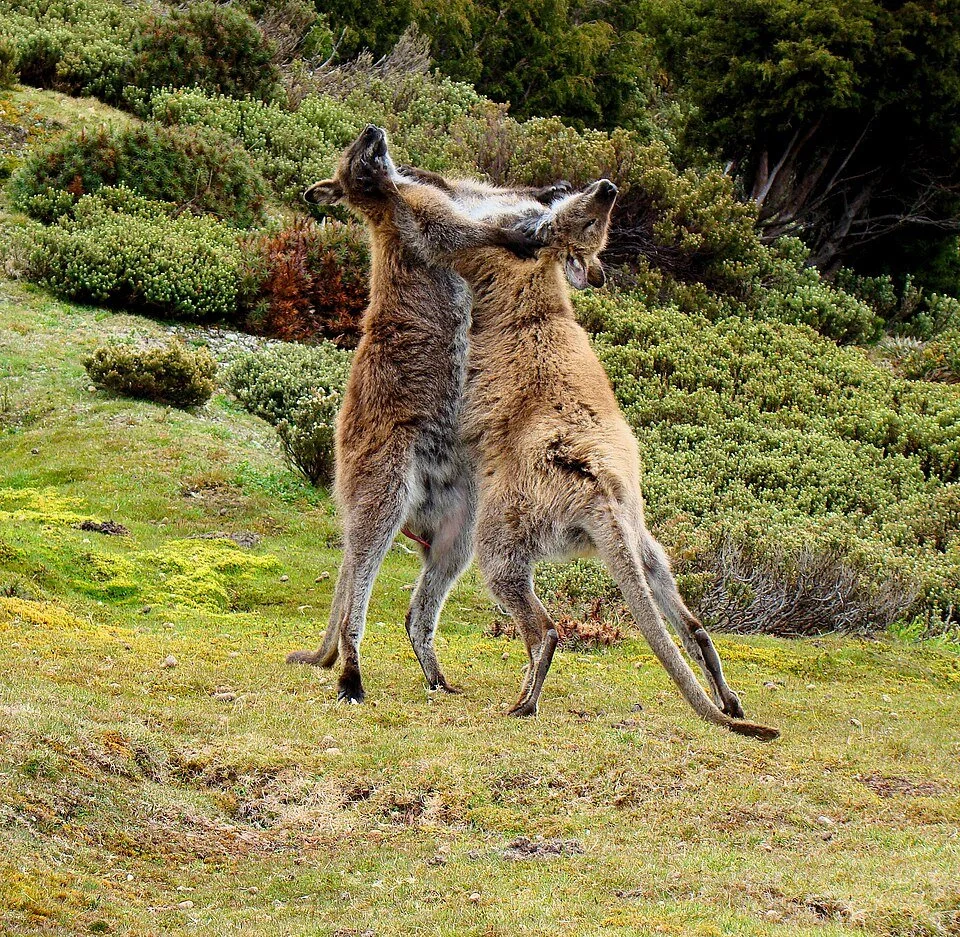
📷 Photo: Bjørn Christian Tørrissen / Wikimedia Commons (CC BY-SA 3.0). Unmodified.
https://commons.wikimedia.org/wiki/File:Wallaby-fighting-Tasmania.jpg
CAPABLE: A Little Balance Challenge for Over 60s
Staying capable as we get older doesn't have to mean complicated exercise routines. Sometimes it's about practising a few simple movements that help us maintain our balance, confidence and independence.
I've started working through this little CAPABLE challenge myself, and I've already discovered a couple of areas that need improvement!
Download the free CAPABLE exercise program below, have a go at your own pace, and let me know how you get on.
I'll be building on the challenge as we go. 😊
https://over60swellness.com.au/s/Stay_Capable_Dude_Routine_Branded-tmfp.pdf
Still Living by KPIs? Maybe It’s Time to Change the Measures
After decades of measuring productivity, deadlines, targets, emails, performance and getting things done, perhaps the measures of a good day need to change as we get older.
Instead of:
Emails answered → walk taken
Tasks completed → time outside
Hours worked → time with people you enjoy
Productivity → enjoyment
Targets achieved → something new tried
Being busy → actually feeling well
Perhaps our personal KPIs could start looking more like this:
How many times did I get outside?
Did I move my body because it felt good — not because I had to?
Did I spend time with someone whose company I enjoy?
Did I do something simply because I wanted to?
Did I learn, try or experience something new?
Did I have some time when absolutely nothing needed to be achieved?
That's a rather different performance review.
Being busy can become a habit
After decades of working, raising families, meeting responsibilities and generally getting things done, being busy can become part of our identity.
Even relaxation can turn into another task. So here's a different sort of performance review.
Mine might look something like:
🌳 Time outside
🚶 Keeping active
☕ Time with people I enjoy
Perhaps it's simply to choose better ones.
Does alcohol feel different after 60?
If you've ever wondered why a couple of drinks seem to have rather more enthusiasm than they used to, there may actually be a physiological reason.
As we age, our body composition changes. We generally have less body water and more body fat, and because alcohol distributes through body water, it has less territory to cover these days!
Then there's something many of us didn't have to think quite so much about in our 30s — medications.
So the answer? Well...
Elevate the standard. Downsize the pour — or perhaps take a leaf out of the younger generation's book and don't drink at all.
Because, as Bob Dylan put it all those years ago...
The times they are a-changin'. 🎵
And apparently, so are we.

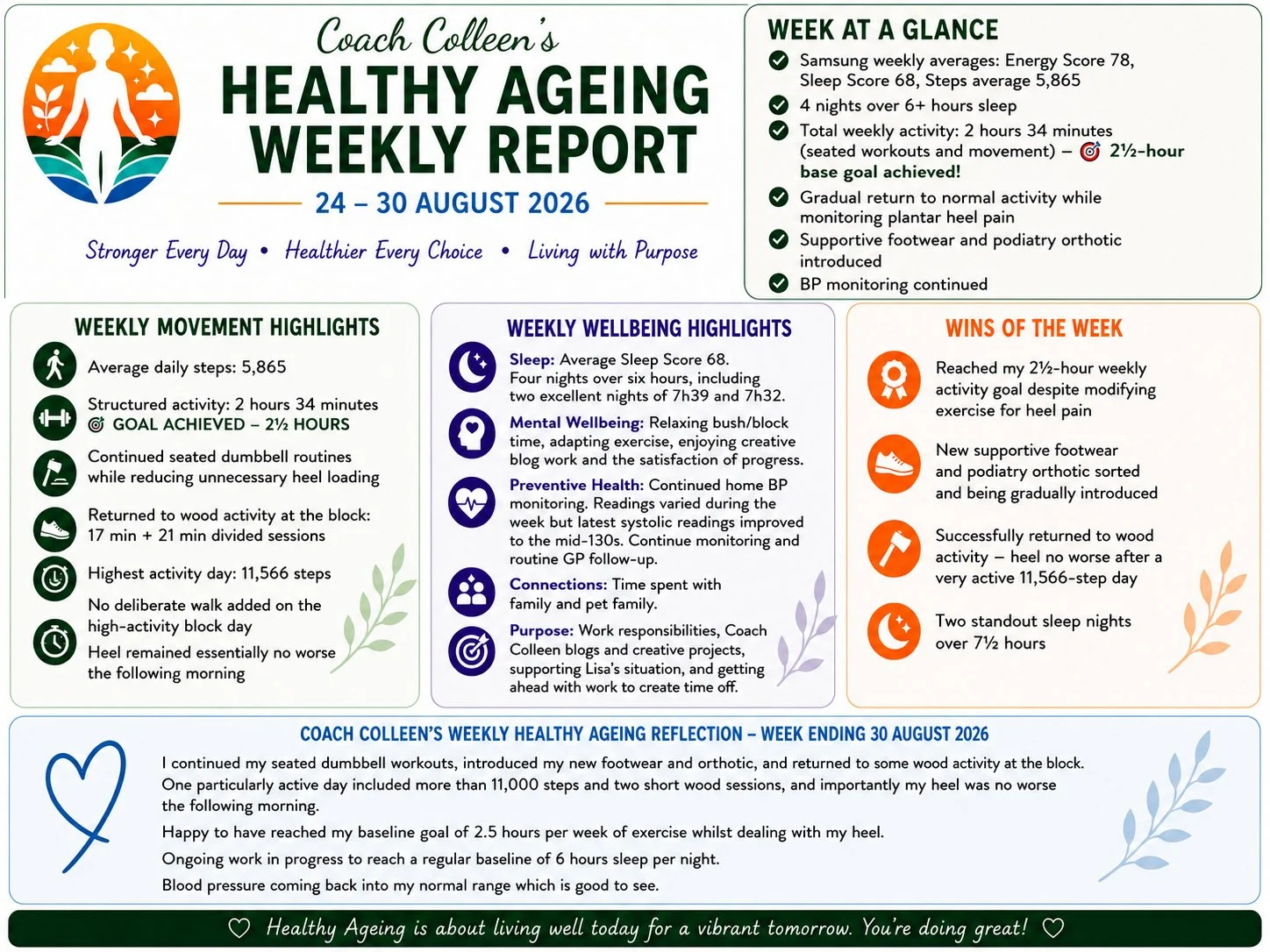
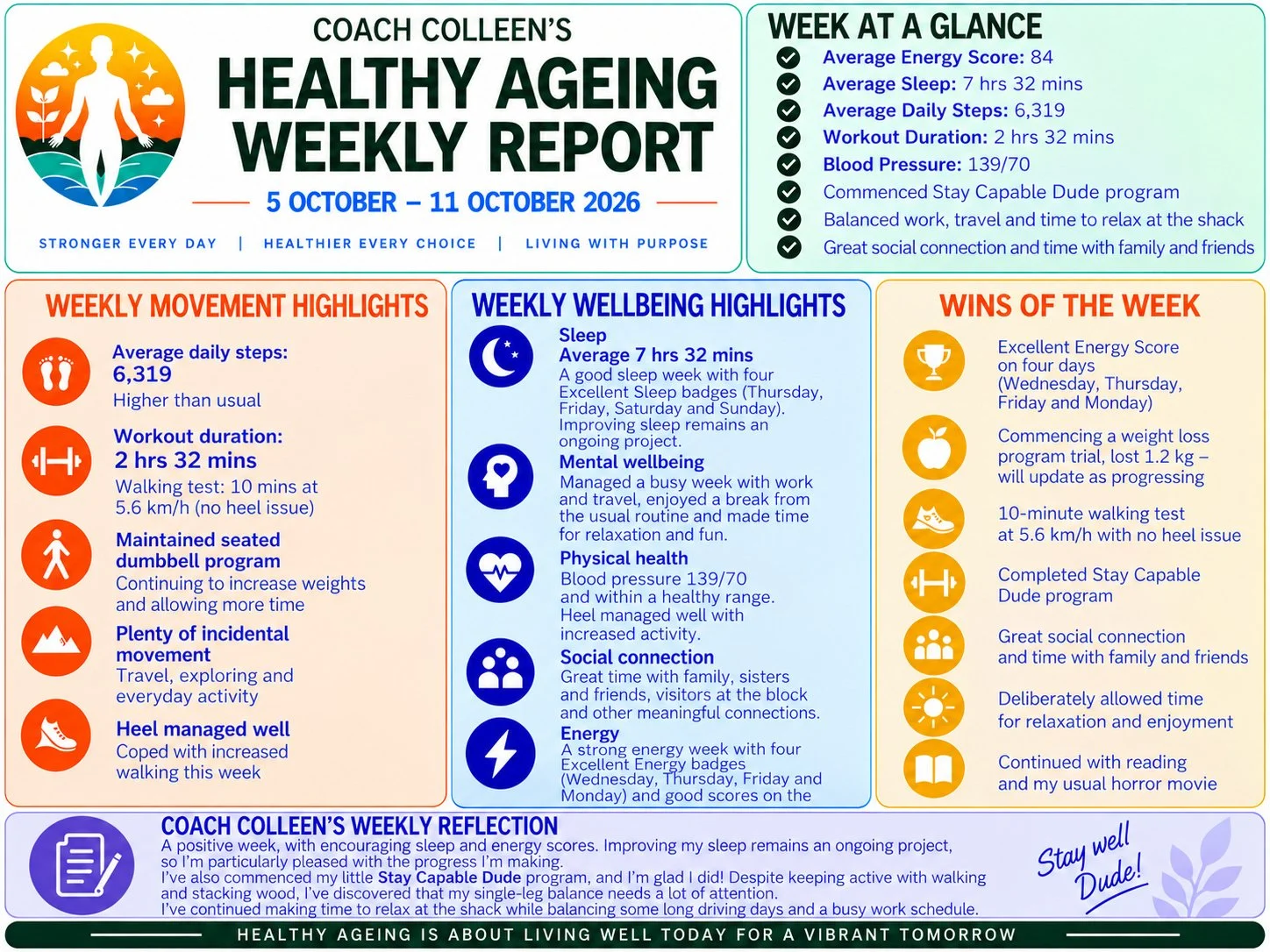
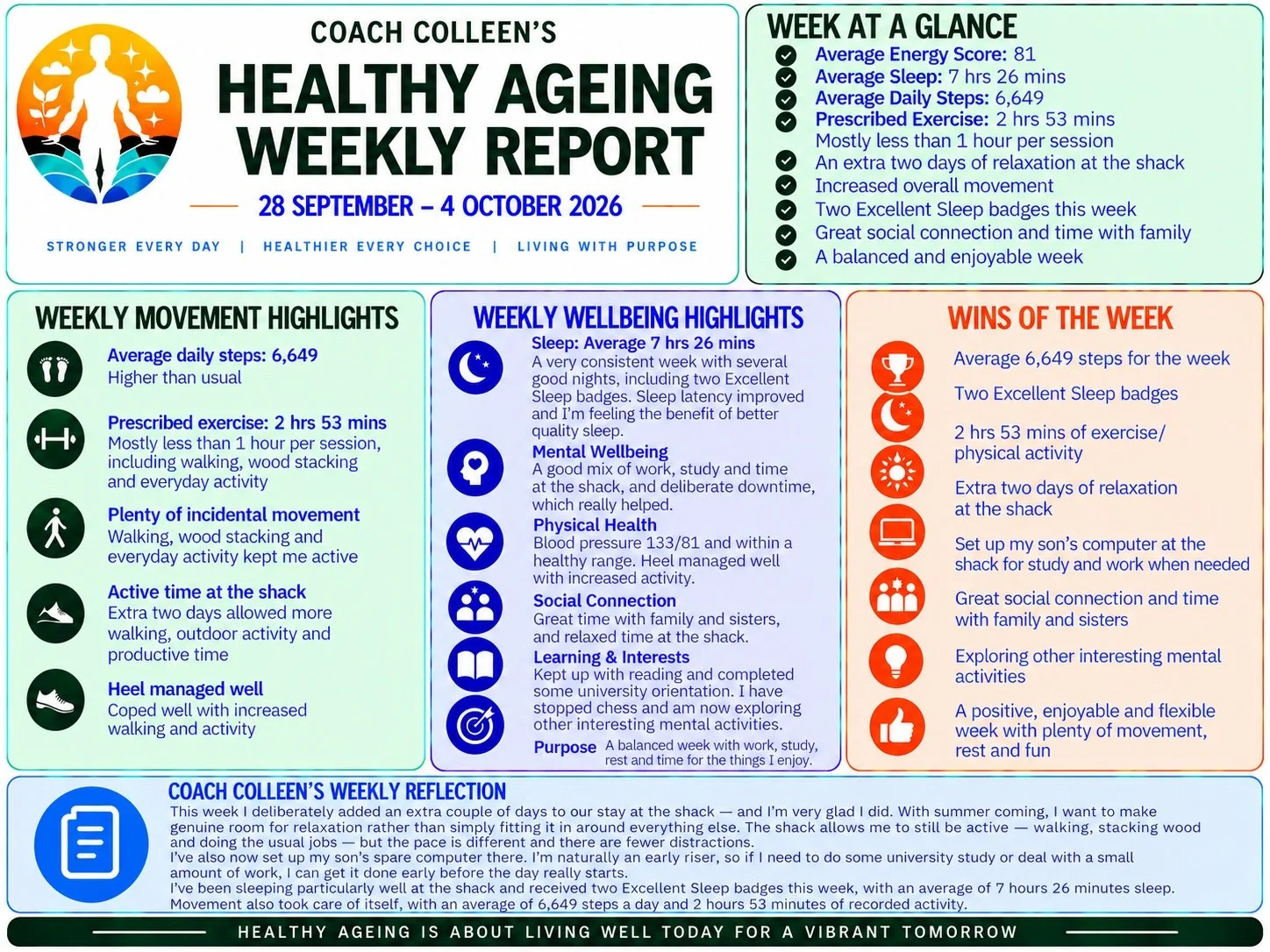
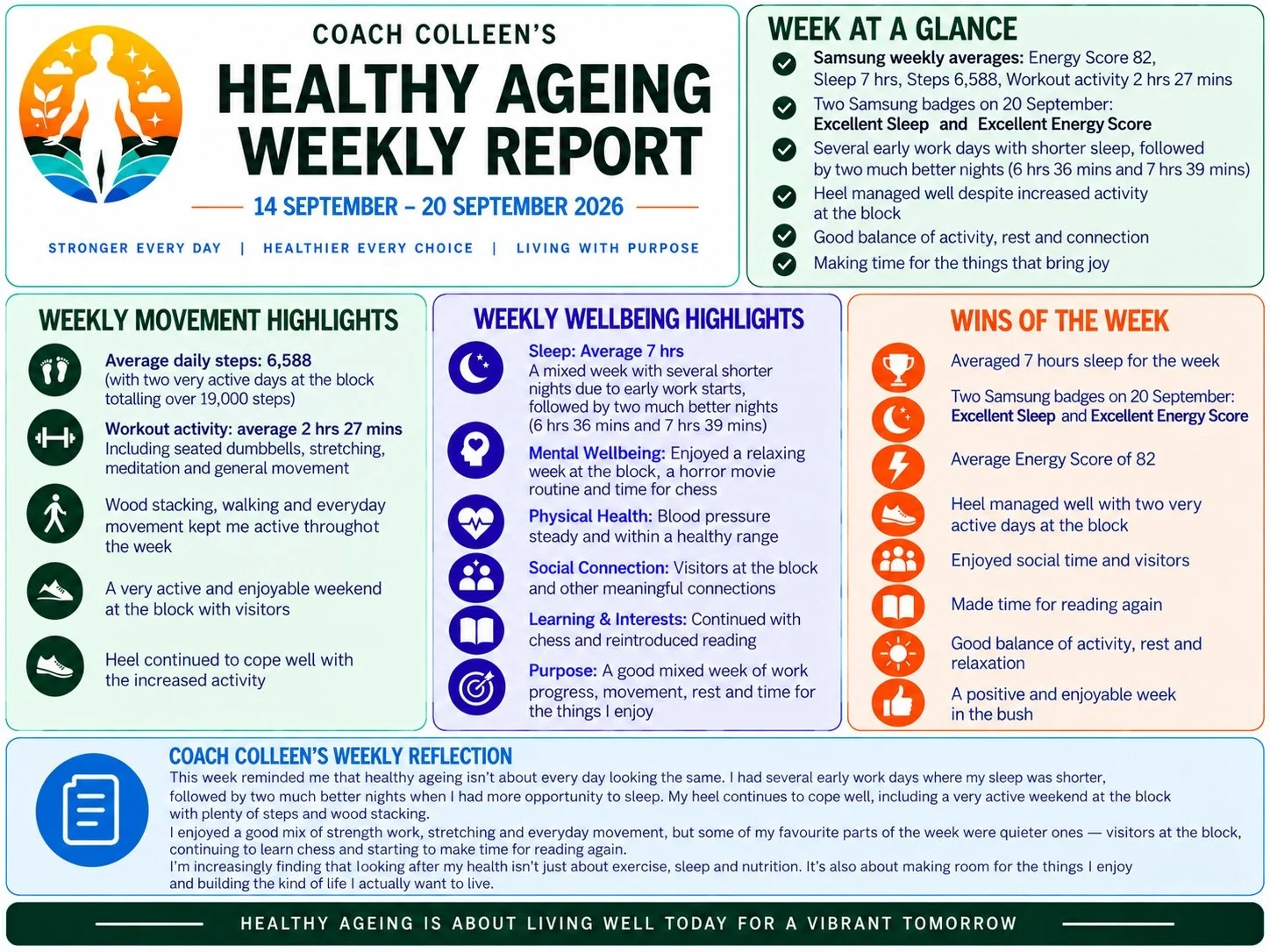
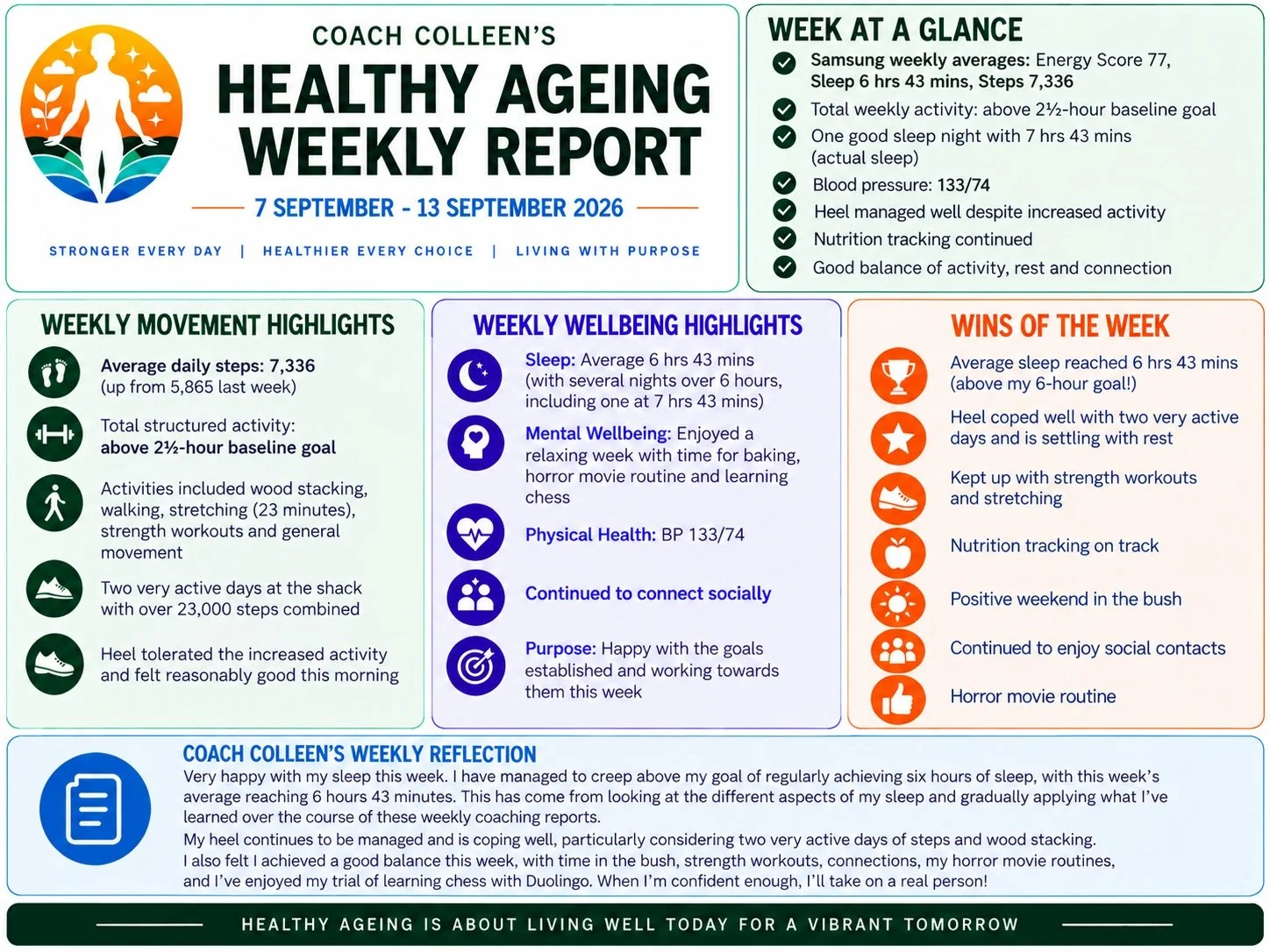
Coach Colleen’s Healthy Ageing Weekly Report — Week Ending 20 September 2026
A mixed week of work, movement and rest — with a seven-hour average sleep, an increasingly cooperative heel, and more time for the things I enjoy. 🌿♟️📚
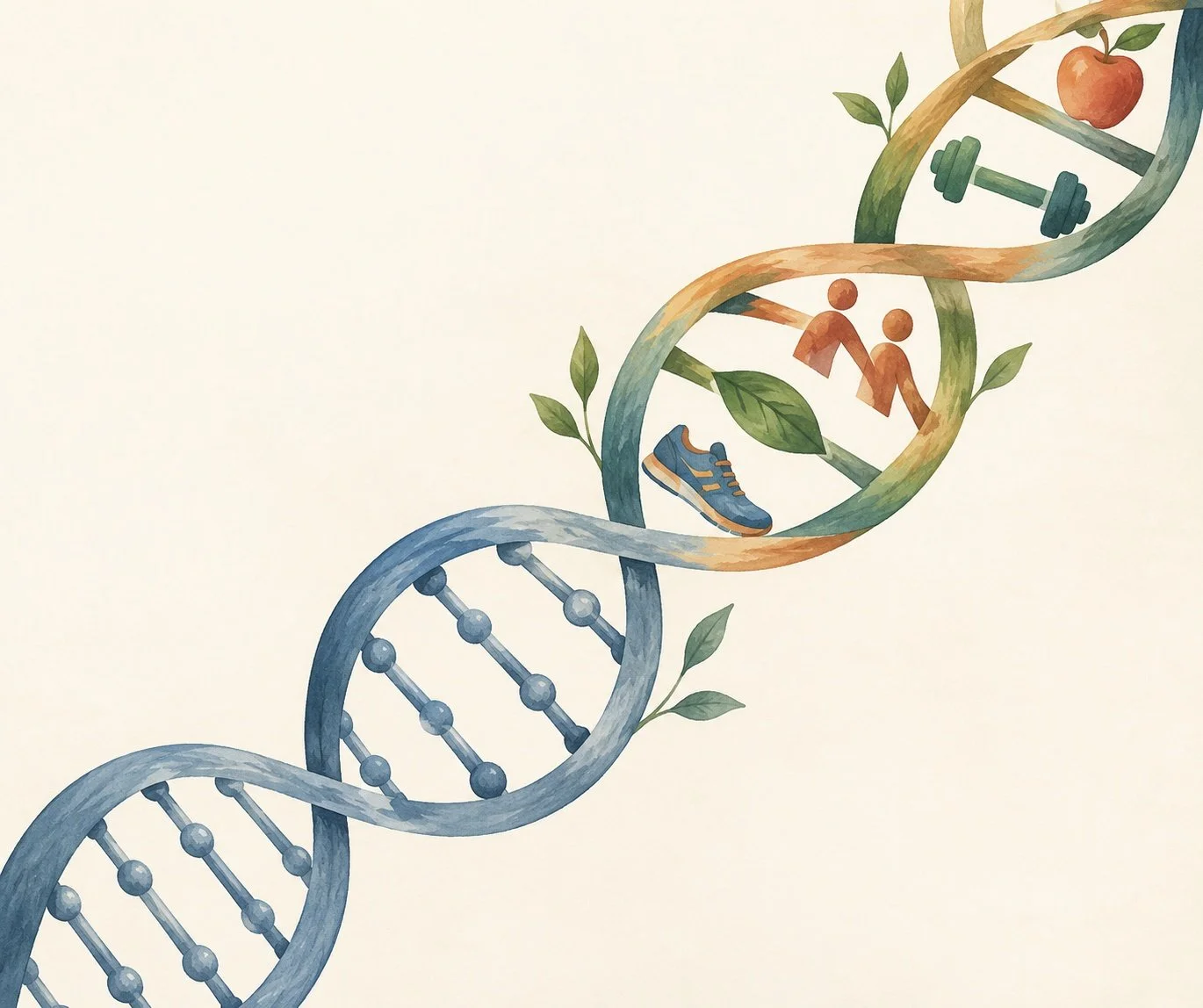
Healthy Ageing Myth: Your genes dictate exactly how you will age 🧬
My Facebook post today was around Healthy Ageing Myths, there are quite a few!
We often look at our parents and grandparents and wonder whether we're getting a glimpse of our own future.
Genes certainly matter. They can influence our susceptibility to particular diseases, aspects of our physical health and even how our bodies respond to some of the things we do.
But how we age isn't written entirely in our DNA.
Physical activity, smoking, diet, social connection, healthcare, environment and other life circumstances all interact with our genes over a lifetime. There are things we can't control about getting older. But there are also plenty of things we can.
You can't choose the genes you were given — but there is still plenty you can influence.
We have had to learn all our lives. Now we need to learn how to relax.
Think about how much we've had to learn over a lifetime.
We learned how to do our jobs. How to raise families. How to pay mortgages, use computers, navigate relationships, cook, drive, manage money and somehow keep up with technology that changes every five minutes.
We've become pretty good at doing.
But perhaps there's something else we need to learn after 60.
How to relax.
And I don't necessarily mean sitting still doing nothing.
So what does relaxation look like after 60?
At this stage of life, perhaps we need to rediscover — or even learn — what actually restores us.
For one person that's sitting quietly with a book. For somebody else it's standing beside a river trying to catch a trout. Someone disappears into the shed. Someone paints. Someone gardens. Someone learns chess.
And apparently someone else watches people being pursued through dark forests by supernatural entities. 👻
The important thing is:
We don't have to be good at it.
And we definitely don't need to turn it into another wellness target.
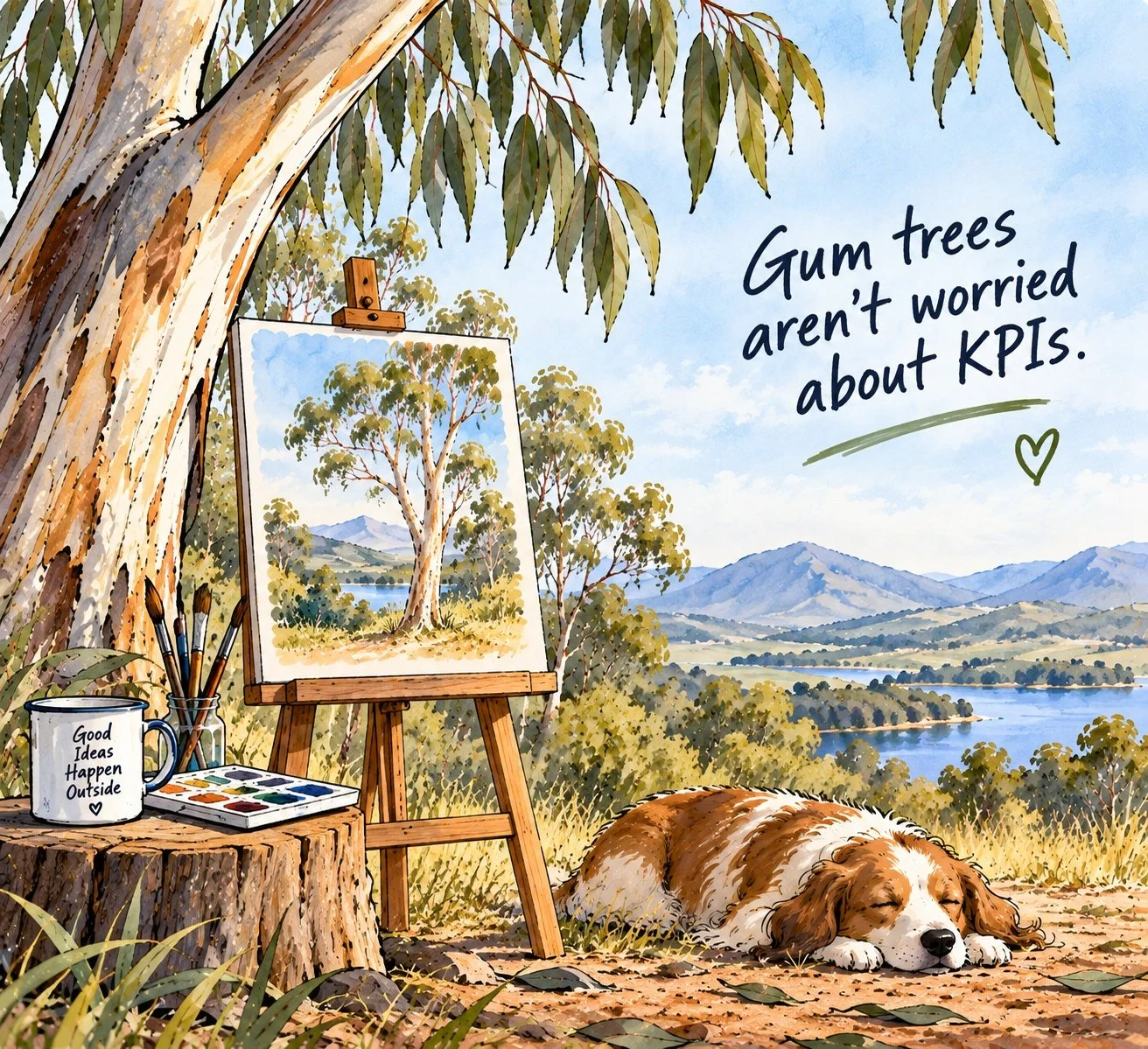
I'm actually working on my own relaxation at the moment. I'm learning chess, in a fun way through Duolingo. I'm planning to have a go at watercolour painting — gum trees rather than masterpieces — and thinking more deliberately about what I enjoy doing simply because I enjoy doing it.
Maybe that's the challenge for this stage of life.
Find your thing.
And whatever you do, don't turn it into another KPI. 🤦♀️
What if your voice could predict your age?
Recent research shows that the voice was the second-best type of measurement for predicting age (Sound of aging: large-scale evidence for a voice-based biological clock). Using just 30 seconds of speech, an AI speech model could predict a person's chronological age to within about four years on average.
So naturally, my first thought was:
What exercise should I be doing to make my voice sound younger?
Be like me — apparently your voice can sound younger if you speak fast! 🏎️
But more seriously, hydration is an important factor. Your vocal folds need adequate moisture to vibrate efficiently.
Staying hydrated keeps your vocal cords from sounding like a creaky attic door swinging open in a horror movie. 😱


Petrol Cars Just Got Overtaken.
We might accept that electric cars are outselling petrol cars. But some things are simply not negotiable.
The best music came from our era — and preferably it was played on vinyl. A handwritten letter meant more than a text message.
We survived perfectly well with a handful of television channels. Now we can scroll through hundreds of them before announcing, “There's absolutely nothing on.”
And perhaps — just perhaps — the 70s and 80s really were a pretty good place to be.
There is something enjoyable about looking backwards. We know how that story turned out.
The trouble is, we can't do the same thing looking forwards.
There's no time machine that lets us pop ahead to 75, 80 or 85, have a quick look at ourselves and come back with a shopping list of everything we should have done differently.
It reminds me of one of my favourite songs, with its wonderfully simple message about doing what you want to do and being who you want to be.
So perhaps keeping a weather eye on where we're heading — and doing a few things now that might help us arrive there a little better — isn't such a bad plan.
Although future me still maintains that music from our era was better! 🎸

The Future Is Under Construction — But Life Is Already Here
A little reflection for this Wednesday...
But there's a peculiar danger in becoming so good at constructing the future that we forget we're already standing in our life.
Maybe positive ageing isn't about trying to feel younger. Maybe it's continuing to have plans for tomorrow while still noticing what's good about Wednesday. And if you're still working, it's hump day — so technically, you're already halfway somewhere.
Happy Wednesday. Keep constructing the future.