
Wallabies, Wisdom and the Third Eye — An Unexpected Lesson in Awareness
The other morning, looking out the window, I found myself watching two wallabies having a rather enthusiastic disagreement.
There was plenty of pushing, grappling and what looked suspiciously like boxing. Apparently, wallabies don't always believe in resolving their differences through quiet discussion!
Of course, this behaviour is quite natural. Male wallabies may engage in physical contests over dominance and access to mates. What looks like a disagreement to us is simply part of their natural behaviour.
But watching them got me thinking about something rather different.
As we get older, do we actually become wiser, or do we just become more experienced at having the same reactions? we don't particularly appreciate. Something doesn't go according to plan.
Does getting older really make us wiser?
We've certainly had more opportunities to learn.
Interestingly, there is.
What a ten-year Stanford University study discovered
A fascinating study published in Psychology and Aging in 2011 examined how our emotional experiences change as we grow older.
Led by psychologist Laura Carstensen at Stanford University, the research involved adults aged between 18 and 94.
Rather than simply asking people whether they considered themselves happy or emotionally stable, the researchers examined their actual emotional experiences throughout everyday life.
Participants reported how they were feeling at five randomly selected times each day over a seven-day period.
The assessments were repeated approximately five and ten years later, allowing the researchers to investigate changes in emotional experiences over time.
And the findings were rather encouraging.
As people grew older, their emotional experiences generally became more positive and more stable.
Participants also became more likely to experience positive and negative emotions at the same time.
That last finding is particularly interesting.
It suggests that emotional maturity may not simply mean being happier or avoiding unpleasant feelings.
It may also involve developing a greater capacity to recognise that life can be both difficult and rewarding at the same time.
We can feel disappointed about one thing while still appreciating another.
But it does suggest that ageing can bring some genuine emotional advantages.
And I think that's worth celebrating.
Research reference
Carstensen, L. L., Turan, B., Scheibe, S., Ram, N., Ersner-Hershfield, H., Samanez-Larkin, G. R., Brooks, K. P., & Nesselroade, J. R. (2011).
Emotional experience improves with age: Evidence based on over 10 years of experience sampling.
Psychology and Aging, 26(1), 21–33.
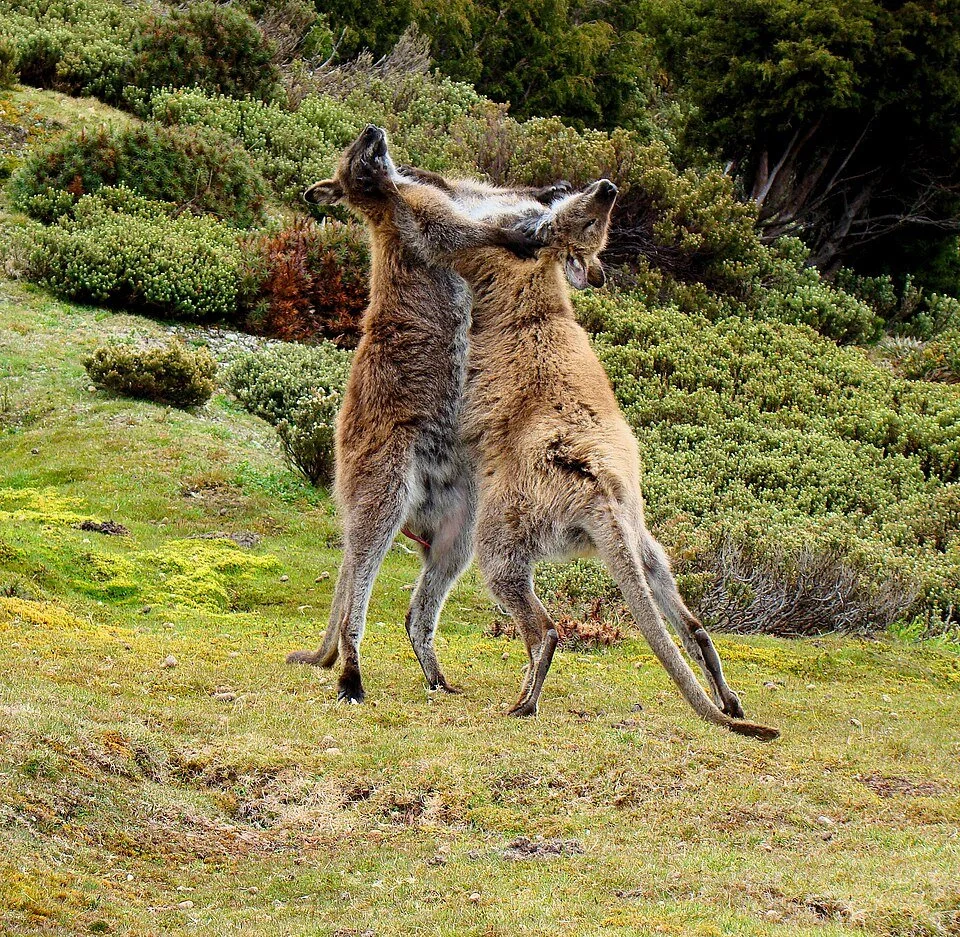
📷 Photo: Bjørn Christian Tørrissen / Wikimedia Commons (CC BY-SA 3.0). Unmodified.
https://commons.wikimedia.org/wiki/File:Wallaby-fighting-Tasmania.jpg
